
Tyre guide · Updated November 2026
The UK tyre pressure guide
Most UK cars need between about 30 and 38 PSI (2.1 to 2.6 bar), often with different figures front and rear and higher figures when the car is fully loaded. Your car's exact figure is on the sticker inside the driver's door pillar, in the fuel filler flap or in the handbook. Check your tyres cold, at least once a month.
Look up your car's pressures →
Contents
- What PSI means
- Where to find your figure
- Pressures for popular UK cars
- How to check your tyres
- Too low or too high
- Loaded cars, front and rear
- Motorway driving and seasons
- Forecourt air machines
- Tyres that keep losing air
- Common mistakes
- Questions
What PSI means
PSI stands for pounds per square inch, the unit most UK drivers and forecourt machines use for tyre pressure. You will also see bar, which is common on European cars and digital gauges (1 bar is about 14.5 PSI), and sometimes kPa (100 kPa is 1 bar). They all measure the same thing, so use whichever your gauge shows. Our PSI to bar chart converts between them.
Where to find the right pressure for your car
- Driver's door pillar. Most cars have a sticker on the edge of the door frame listing pressures for each tyre size, normal and fully loaded.
- Fuel filler flap. Many Peugeots, Citroëns, Vauxhalls and others put the same table inside the flap.
- Owner's handbook. Usually in the "wheels and tyres" or "technical data" section.
- What PSI. Search for your car and pick your tyre size. Your size is printed on the tyre sidewall, for example 205/55 R16.
Don't use the number moulded into the tyre sidewall. That is the most the tyre can safely hold, not what your car needs.
Tyre pressures for popular UK cars
Normal-load figures in PSI for each car's smallest standard tyre size, front / rear. Larger wheels and full loads often need more, so tap your car for every size, the loaded figures and the wheel nut torque.
| Car | Front / rear PSI | Wheel nut torque |
|---|---|---|
| Volkswagen Golf Mk82020–present · 205/55 R16 | 35 / 332.4 / 2.3 bar | 140 Nm |
| Ford Fiesta Mk82017–2023 · 195/60 R15 | 33 / 302.3 / 2.1 bar | 135 Nm |
| Vauxhall Corsa F / Corsa-e2019–present · 195/55 R16 | 33 / 322.3 / 2.2 bar | 115 Nm |
| Ford Puma2019–present · 215/55 R17 | 33 / 332.3 / 2.3 bar | 135 Nm |
| Nissan Qashqai J122021–present · 215/65 R17 | 33 / 332.3 / 2.3 bar | 113 Nm |
| Kia Sportage NQ52021–present · 215/65 R17 | 33 / 332.3 / 2.3 bar | 118 Nm |
| Toyota Yaris Hybrid (Mk4)2020–present · 185/65 R15 | 33 / 332.3 / 2.3 bar | 103 Nm |
| Volkswagen Polo Mk62017–present · 185/65 R15 | 33 / 312.3 / 2.1 bar | 120 Nm |
| Ford Focus Mk42018–2025 · 205/60 R16 | 33 / 302.3 / 2.1 bar | 135 Nm |
| MINI Hatch F562014–2024 · 175/65 R15 | 33 / 322.3 / 2.2 bar | 140 Nm |
| BMW 3 Series G202018–present · 225/50 R17 | 35 / 382.4 / 2.6 bar | 140 Nm |
| Tesla Model Y2022–present · 255/45 R19 | 42 / 422.9 / 2.9 bar | 175 Nm |
Typical figures for UK-spec cars. Always confirm on your door or fuel-flap sticker. Browse all 1,267 vehicles →
How to check your tyre pressure
- Check when the tyres are cold, before you set off or after no more than a couple of miles of gentle driving. Warm tyres read 2 to 4 PSI higher.
- Take the valve cap off and press the gauge or the air line squarely onto the valve until the hissing stops.
- Compare the reading with your car's figure and add air in short bursts until it matches. If a tyre is over, press the pin in the valve briefly to let a little out.
- Do all four tyres, refit the caps, and check the spare if you have one.
- If your car has a tyre pressure monitoring system, you may need to reset it after changing the pressures. The handbook explains how.
How often? At least once a month, and before long journeys, holidays or towing. Tyres naturally lose 1 to 2 PSI a month even with no puncture, and pressure falls by about 1 PSI for every 5 to 6 °C drop in temperature.
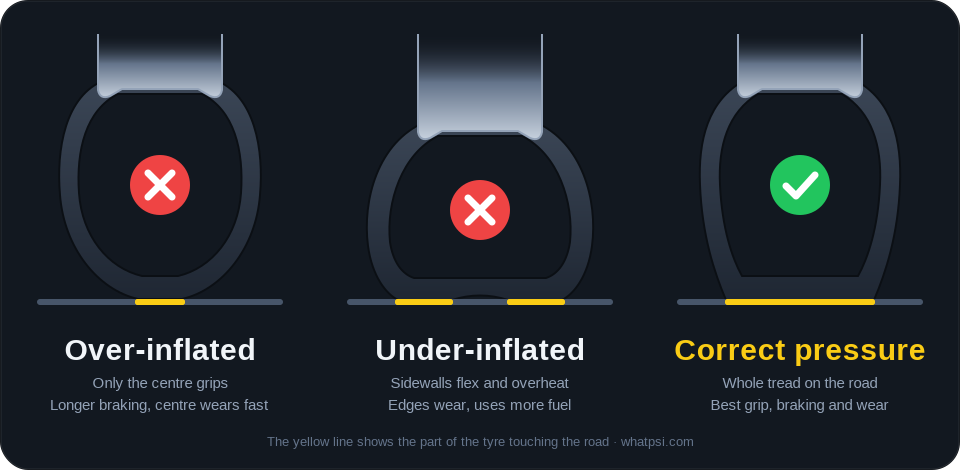
What happens if your tyre pressure is too low or too high
| Too low | Too high | |
|---|---|---|
| Grip and braking | Vague steering, slower response and longer stopping distances, especially in the wet | Smaller contact patch, less grip and longer stopping distances |
| Tyre wear | Both outer edges wear faster | The centre of the tread wears faster |
| Fuel and range | Higher rolling resistance, more fuel used and less range on an EV | Little saving, and not worth the loss of grip |
| Comfort | Wallowy, less stable at speed | Harsh, bumpy ride |
| Biggest risk | The sidewall flexes and overheats, which can lead to a blowout at motorway speeds | More easily damaged by potholes and kerbs |
Loaded cars, front and rear
Most stickers give two sets of figures: one for normal driving with a couple of people on board, and a higher one for a full car, heavy luggage or towing. Use the loaded figures for holidays, a car full of passengers or a trailer, and go back to normal afterwards.
Front and rear figures are often different. Many front-engined cars carry more weight over the front wheels, while estates, people carriers and vans often need much more air at the rear when loaded. More in our towing and heavy loads guide.
Motorway driving and the seasons
Some cars, especially German makes, list a separate figure for sustained high-speed driving or an "eco" setting. If yours does, use it for long motorway runs. Otherwise the normal or loaded figure is correct. Under-inflation is the real danger at speed, because a soft tyre flexes and heats up.
Cold weather lowers tyre pressure, which is why the warning light often comes on after the first frosty morning. Top back up to your normal figure rather than adding extra or letting air out. See cold weather tyre pressure, and electric car tyre pressures if you drive an EV.
Can you trust forecourt air machines?
Forecourt machines are usually close, but their gauges can drift a few PSI and are not always well looked after. A digital pressure gauge of your own costs little and gives you a reading you can trust, and a 12V inflator lets you top up at home with cold tyres instead of after driving to the garage.
Digital pressure gauges on Amazon ↗ · 12V tyre inflators on Amazon ↗
Tyres that keep losing air
If one tyre needs topping up every week or two, something is usually wrong: a slow puncture from a nail or screw, a leaking valve, or corrosion where the tyre seals against an alloy wheel. Have it checked by a tyre fitter, as many slow punctures can be repaired cheaply. If your car has no spare wheel, keep a tyre sealant kit ↗ in the boot to get you there.
A tyre pressure warning light that comes on while driving means at least one tyre has lost pressure. Our warning light guide explains what to do.
Common tyre pressure mistakes
- Inflating to the maximum figure on the tyre sidewall.
- Checking straight after a long drive and letting air out of warm tyres.
- Only checking when the warning light comes on. Most systems only warn once a tyre is well below its correct pressure.
- Using the same figure front and rear when your car lists different ones.
- Forgetting to switch to the loaded figures for holidays and towing, and back again afterwards.
- Ignoring the spare until the day it is needed.
- Over-tightening or guessing wheel nuts after changing a wheel. Look up your car's wheel nut torque and use a torque wrench.
Questions
What PSI should my car tyres be?
Most UK cars need between about 30 and 38 PSI (2.1 to 2.6 bar), but the right figure depends on your exact car, tyre size and load. Use the sticker in the driver's door pillar, the fuel filler flap or your handbook, or look up your car on What PSI.
Is 35 PSI a good tyre pressure?
For many family hatchbacks 35 PSI is close to the normal front figure, but it is only right if it matches your car. Some cars need 30 PSI and others over 40 PSI when loaded, so always check your own car's figure.
Should front and rear tyres have the same pressure?
Not always. Many front-engined cars need a little more air at the front, while some cars need more at the rear, especially when loaded. Use the separate front and rear figures for your car.
Is the PSI on the tyre sidewall the right pressure?
No. The number moulded on the sidewall is the maximum the tyre can take, not the pressure your car needs. Inflating to it gives a harsh ride and less grip.
Should I check tyre pressure hot or cold?
Cold. Tyres warm up as you drive and read 2 to 4 PSI higher. Check before setting off or after a short, gentle drive, and never let air out of warm tyres to reach the cold figure.
How often should I check my tyre pressure?
At least once a month and before any long journey or when the car is fully loaded. Tyres lose roughly 1 to 2 PSI a month even when nothing is wrong.
Are petrol station air machines accurate?
They are often close but can be a few PSI out, and they are not always well maintained. A cheap digital gauge of your own gives you a reading you can trust.
Why does my tyre keep losing pressure?
A tyre that needs topping up every week or two usually has a slow puncture, a leaking valve or a poor seal between the tyre and the wheel rim. Have it checked by a tyre fitter rather than just topping it up.
Can low tyre pressure fail an MOT?
Tyre pressure itself is not measured at the MOT, but tyre condition and tread depth are, and an under-inflated tyre wears its edges quickly. On newer cars a tyre pressure warning light that stays on can also cause problems at the test.
Find your car
Look up the exact front and rear pressures, loaded figures and wheel nut torque for your car.
Open the What PSI app →